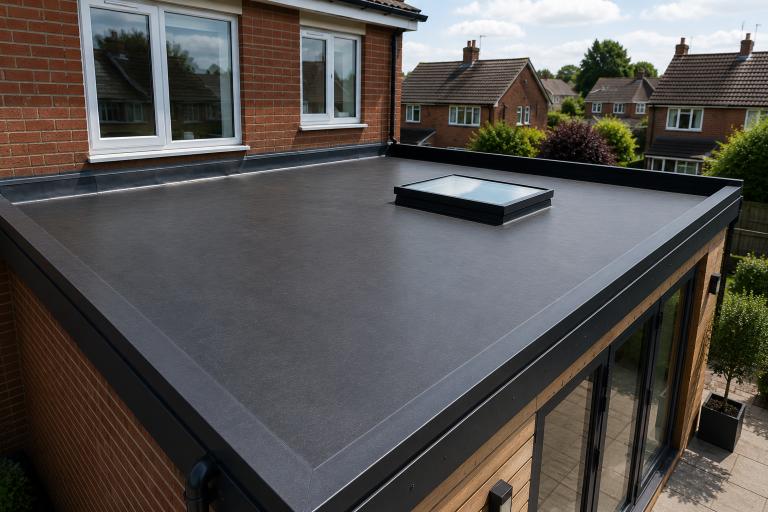
If you have a flat roof on your garage, extension, porch, or bay window and it needs replacing, you will likely be deciding between two options: traditional felt roofing or EPDM rubber roofing. Both are widely used across Brigg and Scunthorpe, and both can be installed by JM Roofing. But they are very different in terms of lifespan, performance, maintenance, and long-term cost.
This guide gives you a straight comparison of both materials so you can make an informed decision before committing to either. At JM Roofing, we install both felt and EPDM rubber flat roofs across North Lincolnshire and will always recommend the right option for your specific situation and budget.
What Is Felt Flat Roofing?
Traditional felt roofing, also known as built-up felt roofing, has been the standard choice for flat roofs across the UK for decades. It consists of multiple layers of bitumen-impregnated felt bonded together, usually with a mineral-surfaced cap sheet on top to provide some UV protection.
Felt is widely available, relatively inexpensive to install, and has a long track record on properties across North Lincolnshire. However, its performance limitations have become increasingly apparent as better alternatives have become available.
How Long Does Felt Last?
A standard felt flat roof typically lasts between 10 and 15 years, though some installations fail earlier, particularly in areas exposed to significant UV, temperature extremes, or standing water. In North Lincolnshire, where winter frost and sustained autumn rainfall put real stress on flat roofing materials, felt roofs at the lower end of their lifespan can fail quickly once deterioration begins.
Advantages of Felt Flat Roofing
The main advantage of felt is cost. It is generally the cheaper option to install upfront, which makes it attractive for smaller jobs or where budget is the primary concern. It is also widely understood by roofing contractors and the materials are readily available.
For a very temporary situation, such as a building that is being demolished or replaced in the near future, felt can provide adequate short-term cover at minimal cost.
Disadvantages of Felt Flat Roofing
The disadvantages of felt are significant and account for why most reputable roofing companies across Brigg and Scunthorpe now recommend EPDM as the preferred flat roofing solution.
Felt relies on multiple overlapping layers bonded together. These layers create seams and joints that are the primary points of failure over time. As the felt ages, it becomes brittle, begins to crack, and the seams start to separate. UV exposure accelerates this process, as does the freeze and thaw cycle of North Lincolnshire winters, which causes the material to expand and contract repeatedly until it fails.
Felt roofs are also prone to blistering in hot weather as moisture trapped between the layers expands, and to pooling water in areas where the drainage fall is insufficient. Both conditions accelerate the deterioration of the material and lead to leaks.
Once a felt roof starts to fail, the failure tends to spread. A patch repair can address one area but the underlying deterioration of the material continues, and homeowners often find themselves paying for repeated repairs on an ageing felt roof before eventually replacing it entirely.
What Is EPDM Rubber Flat Roofing?
EPDM stands for ethylene propylene diene monomer, a synthetic rubber membrane that has been used in flat roofing for decades and is now the preferred alternative to felt for most flat roofing applications across Brigg and Scunthorpe.
Unlike felt, EPDM is installed as a single continuous sheet with no seams or overlaps across the main roof area. It is fully adhered to the roof deck and detailed carefully around edges, upstands, and any penetrations to create a completely watertight seal.
How Long Does EPDM Last?
A properly installed EPDM rubber flat roof can last 40 years or more with minimal maintenance. This is dramatically longer than felt and means that in most cases, an EPDM installation is the last flat roofing job a homeowner needs to arrange for that structure.
Advantages of EPDM Flat Roofing
The advantages of EPDM over felt are substantial and consistent.
No seams across the main roof area. This removes the primary failure point of felt roofing entirely. Without seams to separate, there are far fewer opportunities for water to find its way through.
Flexibility and movement tolerance. EPDM is a rubber membrane that flexes with the roof structure rather than cracking under the stress of thermal movement and freeze and thaw cycles. This is particularly important for flat roofs in North Lincolnshire, where winter conditions put genuine stress on roofing materials.
UV and weather resistance. EPDM does not deteriorate under UV exposure the way felt does. It handles temperature extremes, sustained rainfall, and frost without cracking, blistering, or lifting.
Low maintenance. Once installed correctly, an EPDM roof requires very little ongoing maintenance beyond occasional checks to ensure drains and edges remain clear.
Long-term value. While EPDM typically costs more to install than felt, the dramatically longer lifespan means that the cost per year of service is considerably lower. A homeowner who installs felt may need to replace it two or three times over the same period that a single EPDM installation remains watertight.
Disadvantages of EPDM Flat Roofing
The main consideration with EPDM is the higher upfront installation cost compared to felt. For homeowners on a tight budget, this can be a barrier even though the long-term economics strongly favour EPDM.
Installation also requires a roofer experienced with the material. EPDM detailing around edges, upstands, pipes, and corners requires skill and care to ensure a fully watertight result. A poorly detailed EPDM installation can fail at the edges despite the main membrane performing well.
Felt vs EPDM: A Direct Comparison
| Factor | Felt | EPDM |
|---|---|---|
| Typical lifespan | 10 to 15 years | 40 years or more |
| Seams and joints | Multiple across the roof | None across the main area |
| Performance in frost | Prone to cracking | Flexible and frost resistant |
| UV resistance | Deteriorates over time | Excellent |
| Maintenance required | Regular inspection, repair | Minimal |
| Upfront cost | Lower | Higher |
| Long-term value | Poor | Excellent |
Which Should You Choose for Your Property in Brigg or Scunthorpe?
For the vast majority of homeowners across Brigg and Scunthorpe considering a flat roof replacement, EPDM is the better choice. The lifespan advantage alone makes it worth the additional upfront cost in almost every situation.
Choose EPDM if:
- You want a long-lasting solution that will not need replacing again for decades
- Your flat roof is on a garage, extension, porch, or outbuilding you plan to keep
- You want to minimise ongoing maintenance and the risk of repeated repairs
- Your existing felt roof has failed or is showing widespread deterioration
Consider felt if:
- Budget is severely constrained and upfront cost is the overriding concern
- The structure the flat roof covers is temporary or being replaced in the short term
- A very small area needs covering as an interim measure
In most cases when a homeowner contacts JM Roofing about a failed flat roof across Brigg or Scunthorpe, our recommendation is EPDM. The difference in upfront cost is relatively modest when set against the difference in lifespan, and we want every job we complete to still be performing well in 20 years.
What to Expect from an EPDM Installation with JM Roofing
When we install an EPDM rubber flat roof on a property in Brigg or Scunthorpe, here is what the process involves:
- Free inspection to assess the existing roof deck and identify any underlying issues
- Removal of existing felt and any damaged decking material
- Installation of new OSB or plywood deck where required
- Full installation of the EPDM membrane, fully adhered to the deck
- Careful detailing around all edges, upstands, and any roof penetrations
- Final check to confirm the installation is fully watertight before we leave
Most domestic EPDM installations on garages and extensions can be completed in a single day depending on size and access.
Book a Free Flat Roof Inspection in Brigg or Scunthorpe
If your flat roof needs replacing or you want an honest assessment of its current condition, get in touch with JM Roofing for a free no-obligation inspection. We cover Brigg, Scunthorpe, and all of North Lincolnshire.
Book Your Free Inspection or call us on 07979 811001
You can also read more about our EPDM rubber flat roofing service or see examples of our completed flat roof installations on our projects page.
Frequently Asked Questions
Is EPDM better than felt for a flat roof in North Lincolnshire?
Yes, in almost all cases. EPDM has no seams across the main roof area, lasts 40 years or more, handles frost and temperature extremes without cracking, and requires minimal maintenance. Felt typically lasts 10 to 15 years and is prone to cracking, blistering, and seam failure over time.
How long does a felt flat roof last in Brigg?
A standard felt flat roof typically lasts between 10 and 15 years, though North Lincolnshire winters can accelerate deterioration on older or poorly installed felt roofs.
How long does an EPDM flat roof last in Scunthorpe?
A properly installed EPDM rubber flat roof can last 40 years or more with minimal maintenance, making it one of the most durable flat roofing options available.
Why does felt flat roofing fail?
Felt fails primarily at its seams and overlaps, which separate over time as the material becomes brittle with age, UV exposure, and thermal movement. It is also prone to blistering in heat and cracking in frost.
Does EPDM roofing cost more than felt in Brigg?
EPDM typically costs more to install than felt upfront. However, given its dramatically longer lifespan, the cost per year of service is considerably lower than felt, which may need replacing two or three times over the same period.
Can JM Roofing install EPDM flat roofs in Brigg and Scunthorpe?
Yes. JM Roofing installs EPDM rubber flat roofs on garages, extensions, porches, and outbuildings across Brigg, Scunthorpe, and North Lincolnshire. Get in touch for a free inspection and quote.
How do I know if my flat roof needs replacing?
Signs include visible cracking, blistering, or lifting of the felt surface, damp patches on the ceiling below the flat roof, water pooling on the surface 48 hours after rain, or a roof that is approaching or past 10 to 15 years old.
Does JM Roofing offer free flat roof inspections in North Lincolnshire?
Yes. We provide free no-obligation inspections for all flat roof enquiries across Brigg, Scunthorpe, and the wider North Lincolnshire area.